Gantry Advertising in Bengaluru: Overhead, Skywalk and Underpass Media
The head-on format. Read straight down the lane, not from the side.
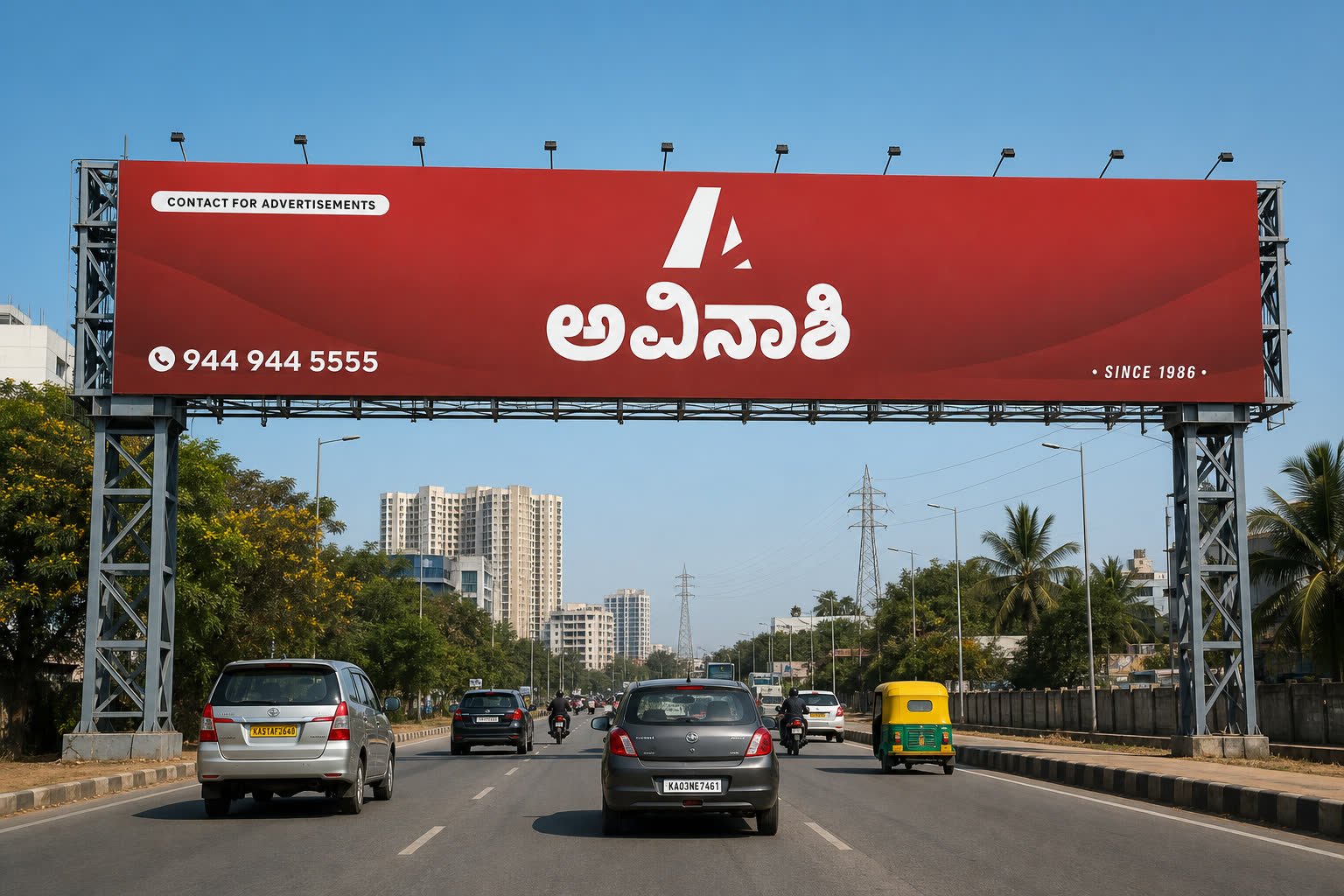
A gantry is an advertising structure that spans across the carriageway overhead, so the face sits directly in the driver's line of travel rather than off to one side. It is the only large outdoor format read head-on, which makes it near-impossible to miss and correspondingly demanding on structural engineering and statutory clearance.
What gantry advertising actually is
Every roadside format asks the viewer to look sideways. A gantry does not. Because the structure spans the road and the face hangs in the centre of the carriageway, an approaching driver is already looking at it, since it occupies the same visual field as the road ahead. That geometry is the entire argument for the format, and it is why gantries typically outperform equivalent-sized roadside boards on the same stretch.
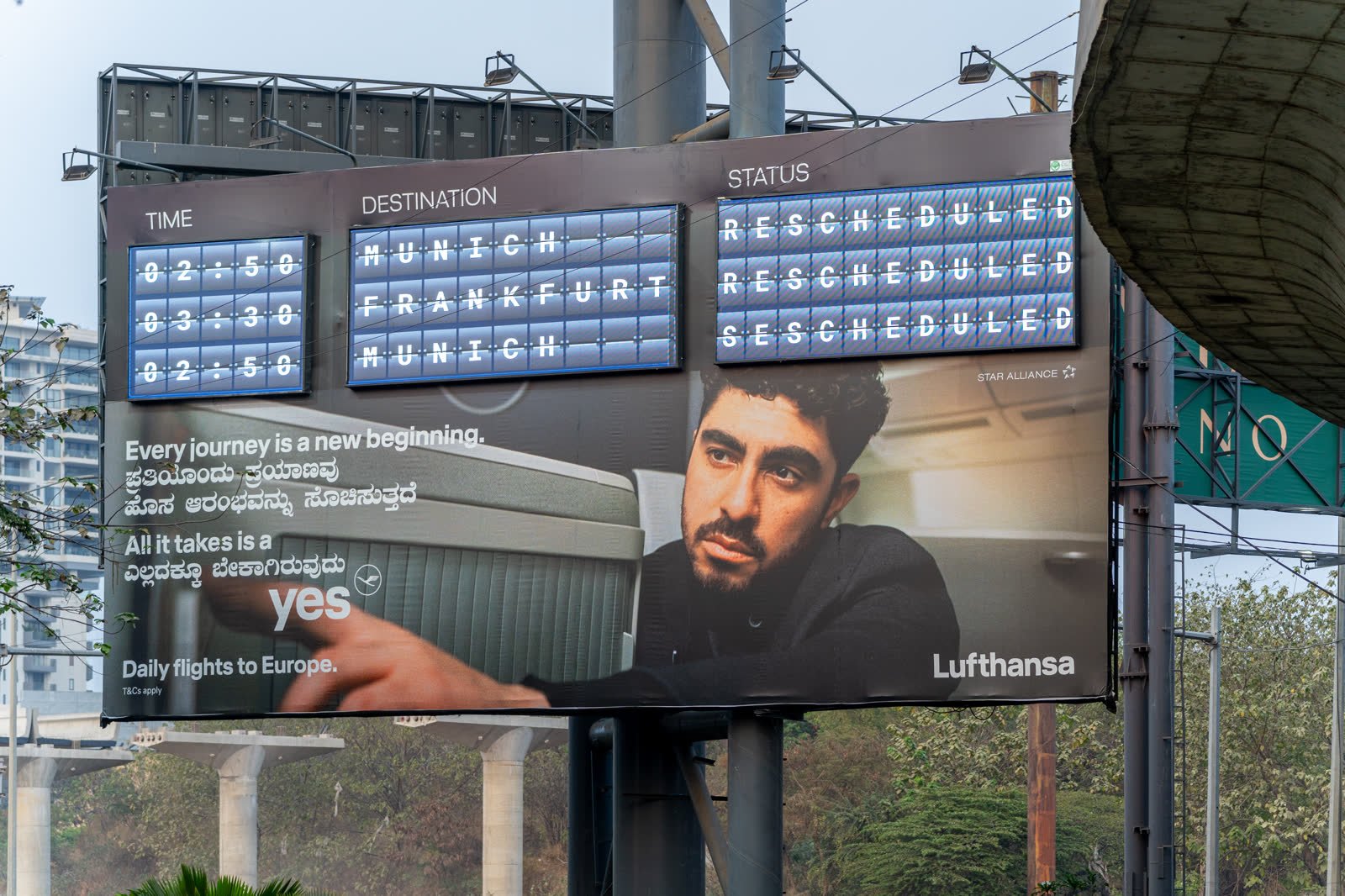
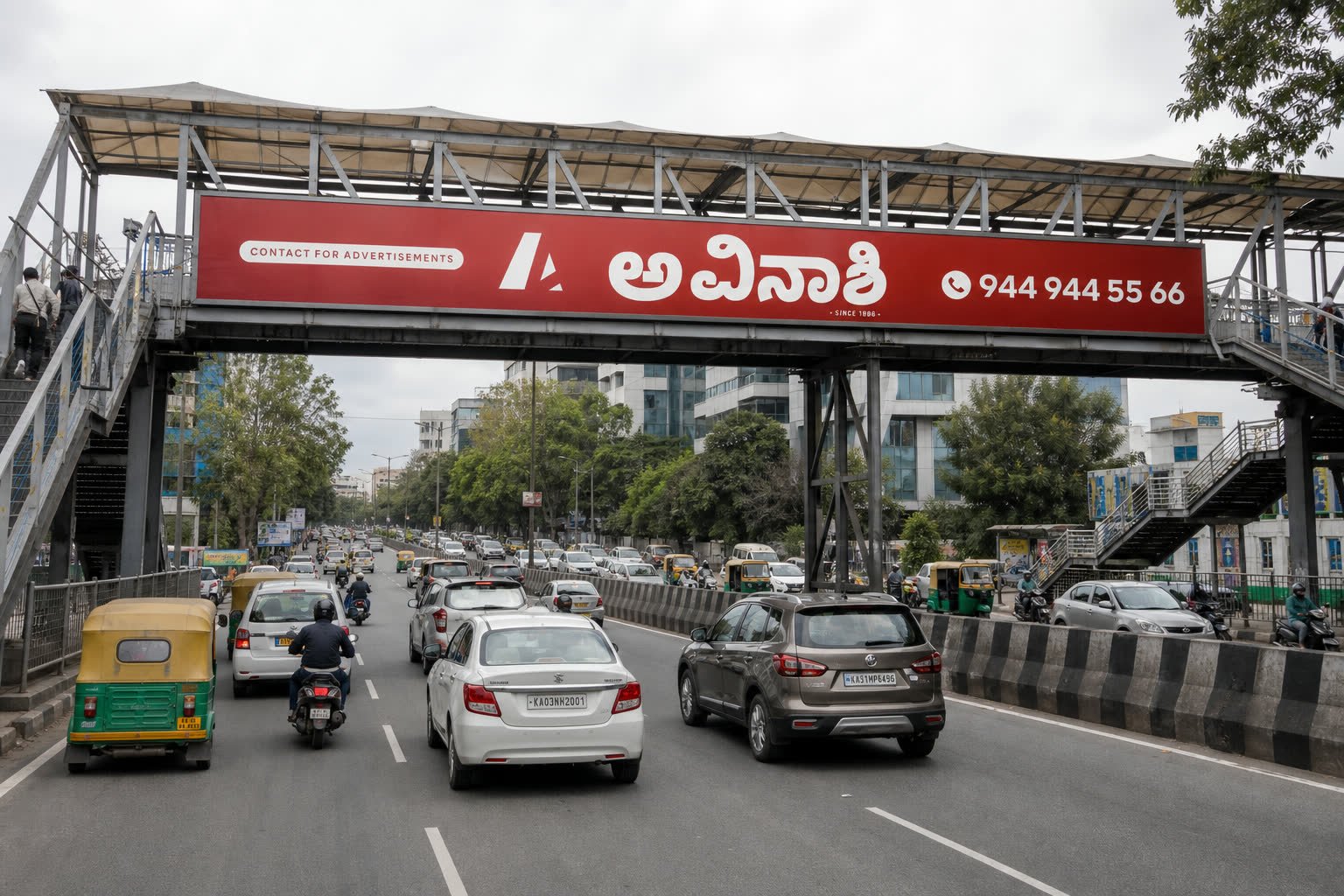
In Bengaluru, gantry media takes three physical forms. There are purpose-built overhead structures spanning arterial roads; there is media mounted on pedestrian skywalks, which already cross the carriageway and present a broad continuous face; and there are underpass installations, where the enclosed approach concentrates attention with almost no competing visual clutter.
The format's constraint is engineering, not availability of ideas. A structure suspended over live traffic carries an entirely different risk profile from one planted on a verge. Span load, wind loading across an unsheltered crossing, and statutory vertical clearance above the carriageway all have to be resolved before the site is worth discussing commercially. Installation and maintenance also require traffic-managed night windows, which affects both scheduling and cost.
Underpasses deserve separate mention because they behave differently from open-road gantries. Traffic slows on entry, ambient light is controlled, and the driver has nowhere else to look. Illumination quality matters more there than anywhere else in outdoor. An underlit panel in an underpass reads as neglected in a way the same panel would not on an open road.
Where gantries work in Bengaluru
Outer Ring Road spans
The corridor with the most multi-lane crossings in the city. A single gantry covers every lane of an eight-lane carriageway at once, which no roadside board can do.
Hosur Road and the Electronic City approach
The elevated expressway and its service roads create separated traffic layers, and overhead structures address the service-road flow head-on.
Bellary Road and the airport corridor
Long, high-speed approaches where head-on visibility compensates for the reduced dwell that comes with faster traffic.
Pedestrian skywalks at major junctions
Skywalks already span the road and carry a broad continuous face, so they deliver gantry geometry at high-footfall crossings without a purpose-built span.
Underpasses
Enclosed approaches with slowed traffic and controlled ambient light. The highest attention density of any road format, provided the illumination is right.
Whitefield and Old Madras Road
Eastern arterial crossings serving the tech-park commute, with reliable peak-hour queueing under the span.
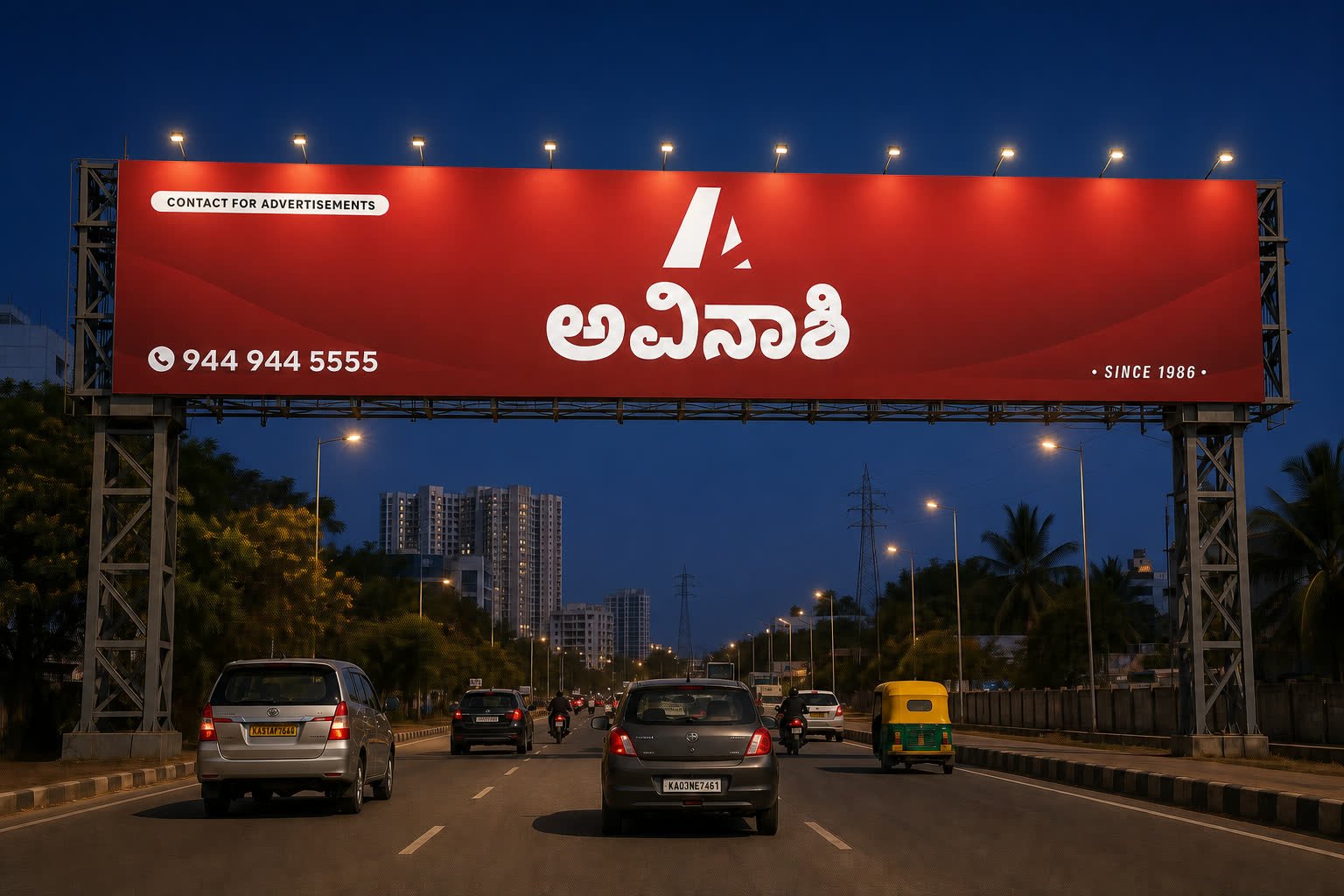
Gantry installations across Bengaluru
What determines the cost
- Span width
- Structure cost scales with the crossing. A gantry over an eight-lane arterial is a materially different engineering job from one over a four-lane road.
- Site tier
- Priced on the traffic volume passing beneath and the speed at which it moves.
- Structure type
- Media on an existing skywalk is cheaper than a purpose-built overhead span, because the structure and its clearances already exist.
- Illumination
- Front-lit spans and backlit underpass panels carry fixture and running cost above non-lit equivalents. In an underpass, this is not optional.
- Installation complexity
- Traffic-managed night windows, lifting equipment and crew are a real line item and higher than for roadside formats.
- Statutory clearance
- Structural certification and clearance verification carry professional fees, and take time before a site can go live.
- Duration
- Gantries are typically taken on longer cycles than roadside boards, and priced accordingly.
We quote per site after survey, with media, production, statutory fees and taxes itemised separately rather than rolled into a single figure.
Approvals, compliance and structural requirements
- 01
Outdoor advertising in Bengaluru sits under the Karnataka Open Places (Prevention of Disfigurement) Act, 1981, together with the advertisement bye-laws of the civic body for the ward in question.
- 02
Bengaluru's outdoor regime has changed repeatedly since the 2018 advertisement bye-laws and the Karnataka High Court directions that followed, and the civic structure itself was reorganised under the Greater Bengaluru Governance Act. Permitted formats, permitted sites and the sanctioning authority are therefore confirmed per site at the time of quoting, never assumed from a previous campaign.
- 03
Structures spanning a public carriageway require clearance from the road-owning authority in addition to advertisement sanction, and where the road is a state or national highway the relevant highway authority is involved as well.
- 04
Statutory minimum vertical clearance above the carriageway is verified per site and is non-negotiable. Getting this wrong is a vehicle-strike risk, not a paperwork problem.
- 05
A structural stability certificate from a licensed structural engineer is mandatory, covering span load and wind loading across an unsheltered crossing. Certification is re-verified periodically over long campaigns and after severe weather.
- 06
Installation and maintenance run in traffic-managed night windows with the required intimation to traffic police. Daytime work over a live carriageway is not an option.
- 07
GST applies on the media and production invoice. Statutory advertisement fees, where levied, are billed at actuals against the sanction receipt.
How a campaign runs, start to finish
- 01
Corridor selection
Gantries suit arterial and high-speed corridors. We start from where head-on geometry actually adds value over a roadside face.
- 02
Structural and clearance feasibility
Span, load and vertical clearance assessed before any commercial discussion. Sites that fail here fail early, which is the point.
- 03
Authority clearance
Advertisement sanction plus road-owning authority clearance, and highway authority approval where applicable.
- 04
Approach-angle simulation
We check the face against the actual approach at travelling speed, including flyover shadow and overhead sign interference.
- 05
Booking
Site, span, illumination and duration confirmed.
- 06
Artwork and print
Wide-aspect creative built for the span. Layouts designed for a standard hoarding rarely transfer without rework.
- 07
Night-window installation
Mounting under traffic management with the required intimation, followed by a load and fixing check.
- 08
Post-install audit
Day and night verification from the approach lane, confirming alignment, tension and illumination coverage across the full face.
- 09
Periodic inspection
Structural and condition checks through the run, with additional inspection after severe weather.
Best suited for
- Campaigns needing unmissable arterial presence rather than broad site count
- Brand statements where a single dominant position outperforms several smaller ones
- Multi-lane corridors where a roadside board only addresses the nearest lanes
- Underpass and skywalk placements targeting slowed, attentive traffic
- Long-duration presence campaigns rather than short tactical flights
- Categories that benefit from perceived scale: real estate, automotive, banking and telecom
What we have executed in this format
Ongoing
Overhead and skywalk installations across Bengaluru arterials
Gantry placements spanning skywalks, underpasses and arterial roads, each taken through approach-angle simulation, load calculation and post-install audit before going live.
2022 to present
Civic corridor structures
Overhead and civic-zone structures delivered under our BDA public-private partnership and the Hubli-Dharwad municipal tender, executed to published civic specifications with structural review at every stage.
Gantry advertising in Bengaluru: frequently asked questions
What is a gantry in outdoor advertising?
A gantry is an advertising structure that spans across the road overhead, placing the face in the driver's direct line of travel. Unlike a roadside hoarding, which is read at an angle from the side, a gantry is read head-on, which is why it is the hardest large format to overlook.
How is a gantry different from a hoarding?
Position and geometry. A hoarding sits beside the road and addresses the nearest lanes at an angle; a gantry spans the carriageway and addresses every lane head-on. The gantry costs more to build and clear, and delivers a dominant single position rather than a distributed site count.
Do gantry structures need special approvals in Bengaluru?
Yes, more than roadside formats. Alongside advertisement sanction, a gantry needs clearance from the road-owning authority, verified statutory vertical clearance above the carriageway, and a structural stability certificate covering span and wind loading. Where the road is a state or national highway, the highway authority is involved too.
Can advertising be placed on skywalks and foot over bridges?
Yes. Skywalks already span the carriageway, so they deliver gantry geometry with a broad continuous face and also reach pedestrians crossing at eye level. We cover the pedestrian-facing side of that in detail on our skywalk and foot over bridge page.
Does underpass advertising work?
It works well, for reasons specific to the environment: traffic slows on entry, ambient light is controlled, and there is almost no competing visual clutter. The one thing that must be right is illumination, because an underlit panel in an underpass reads as neglected.
How long does gantry installation take?
The installation itself is a night-window job under traffic management. The lead time sits earlier, in structural feasibility and authority clearance, which is why gantry go-live timelines are longer than for a roadside hoarding on an already-sanctioned site.
What artwork dimensions do gantry faces need?
Gantry faces are wide-aspect (considerably wider than tall) and sized to the specific span. Creative built for a 40 × 20 hoarding rarely transfers without a rework, so we supply exact print dimensions and safe area per structure.
Planning a gantry campaign in Bengaluru?
Tell us the audience and the window. We will come back with sites, availability and an itemised quote.