Types of Outdoor Advertising
If you are new to outdoor advertising, the vocabulary gets in the way before the decision does. Hoarding, unipole, gantry, DOOH, backlit, flex. This page explains what each of the eight formats is in plain terms, so you can tell them apart and say what you are looking for.
Written by Avinashi Ads, an outdoor advertising company working across Bengaluru and Karnataka since 1986. Availability, locations and pricing all depend on the specific campaign, so those are not published here. Tell us what you have in mind and we will put together a proposal.
What outdoor advertising is
Outdoor advertising, also called out-of-home advertising or OOH, is advertising that reaches people while they are out in public space rather than at home in front of a screen. It is not something an audience scrolls past, blocks or skips.
What separates one format from another is the viewing condition. A large roadside board is read for a few seconds at speed, by someone who will pass it again the next day. A bus shelter panel is read for minutes, from a few metres away, by someone waiting with nothing else to do. Both are outdoor advertisements, but they suit completely different messages.
The second difference is light. A great deal of city movement happens after sunset, so whether a face is lit, and whether it is lit from the front or from behind, decides how many hours of the day it is actually working.
The third is permission. Outdoor advertising in Bengaluru falls under the Karnataka Open Places (Prevention of Disfigurement) Act, 1981 and the advertisement bye-laws of the relevant civic body. Rules differ by format and location and have changed several times, which is why permissibility is established for each site individually rather than assumed.
The eight formats, side by side
The quickest way to tell the formats apart. Read the last column first. Who sees the advertisement, and for how long, is the difference that matters most.
| Format | Typical size | Illumination | Who sees it |
|---|---|---|---|
| Hoardings | 40 ft × 20 ft standard | Front-lit on main roads | Drivers at speed, for a few seconds at a time |
| Transit Media | Bus wraps, station and platform panels | Backlit at stations, daylight on vehicles | Commuters mid-journey, often for minutes |
| Digital LED Displays | LED screens, sized to the structure | Self-lit, adjusts to ambient light | Junction traffic, in a rotating slot |
| Gantry | Wide-aspect, spanning the road | Front-lit, backlit on enclosed faces | Drivers head-on, in the line of travel |
| Unipoles | 40 ft × 20 ft per face, usually double-sided | Front-lit after dark | Traffic moving in both directions |
| Bus Shelters | 6 ft × 4 ft panels | Backlit, switches on at dusk | Waiting commuters, at close range and at rest |
| Skywalk / FOB | Deck face plus eye-level panels | Backlit or front-lit | Drivers below and pedestrians crossing |
| Glow Signs | Custom to the storefront | Internally lit | Passers-by at your own premises, after dark |
Sizes shown are the standard specification for each format. Actual dimensions and illumination vary by site.
The eight formats, explained
What each format is, who sees it, and how to recognise it. If one looks right for your campaign, use the enquiry link in that section and we will take it from there.
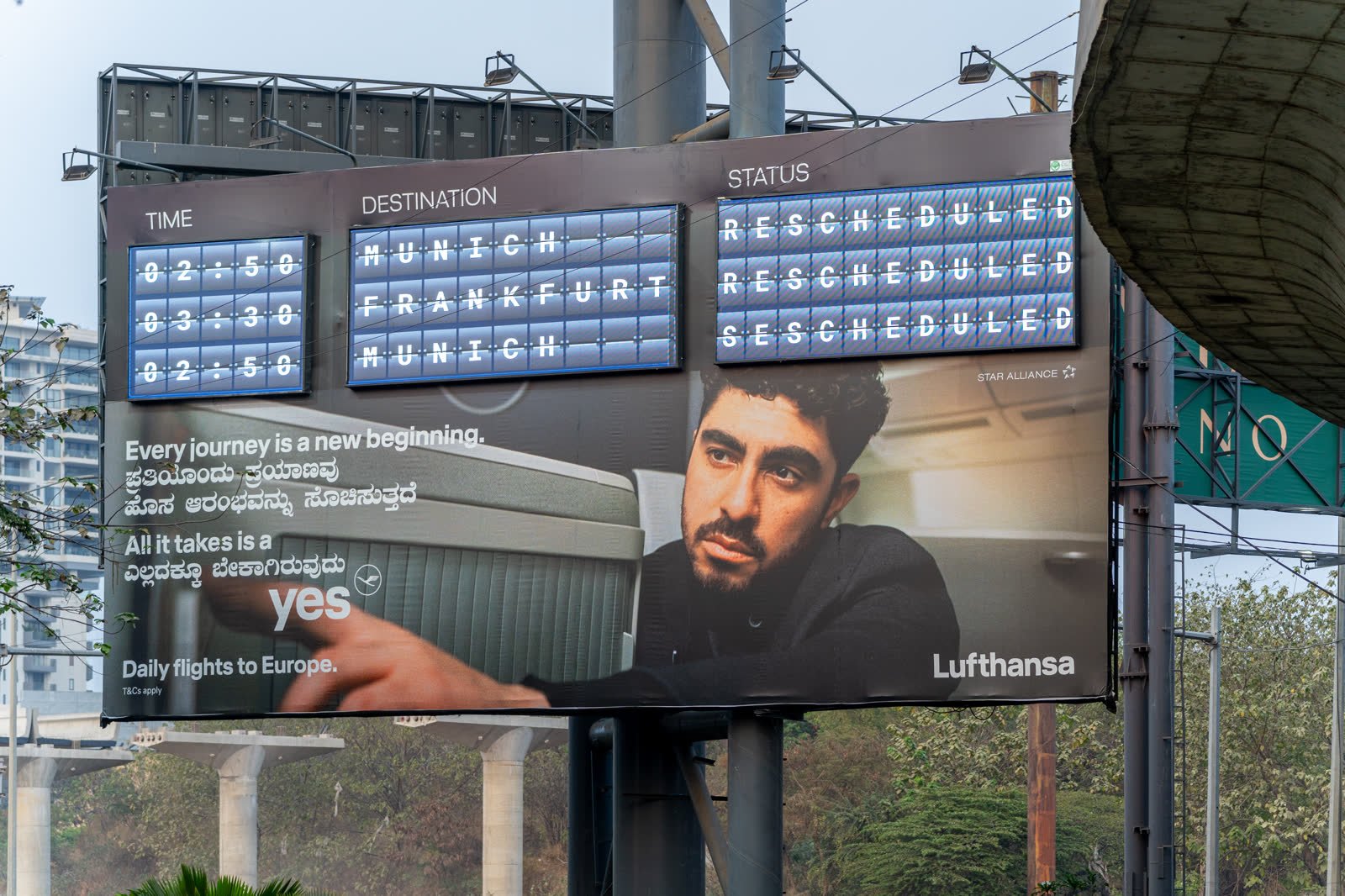
Hoardings
The large-format roadside board, still the highest-recall unit in outdoor.
A hoarding is a large static roadside display, typically 40 ft × 20 ft, mounted on a fabricated steel structure and positioned for a long, unobstructed approach view. It remains the highest-recall format in Bengaluru outdoor advertising because it is read at speed, repeatedly, by the same commuter on the same route every day.
Typical size
40 ft × 20 ft standard
Illumination
Front-lit on main roads
Who sees it
Drivers at speed, for a few seconds at a time
Considering hoardings for a campaign? We will check what is available and send you a quote.
Enquire about HoardingsTransit Media
The format that travels with the commuter instead of waiting for them.
Transit media places advertising on and around the systems people use to move through Bengaluru: Namma Metro stations and viaduct pillars, BMTC buses, and railway stations and platforms. Its advantage is dwell: a commuter waiting on a platform or sitting in traffic behind a branded bus gives the message minutes of attention rather than seconds.
Typical size
Bus wraps, station and platform panels
Illumination
Backlit at stations, daylight on vehicles
Who sees it
Commuters mid-journey, often for minutes
Considering transit media for a campaign? We will check what is available and send you a quote.
Enquire about Transit Media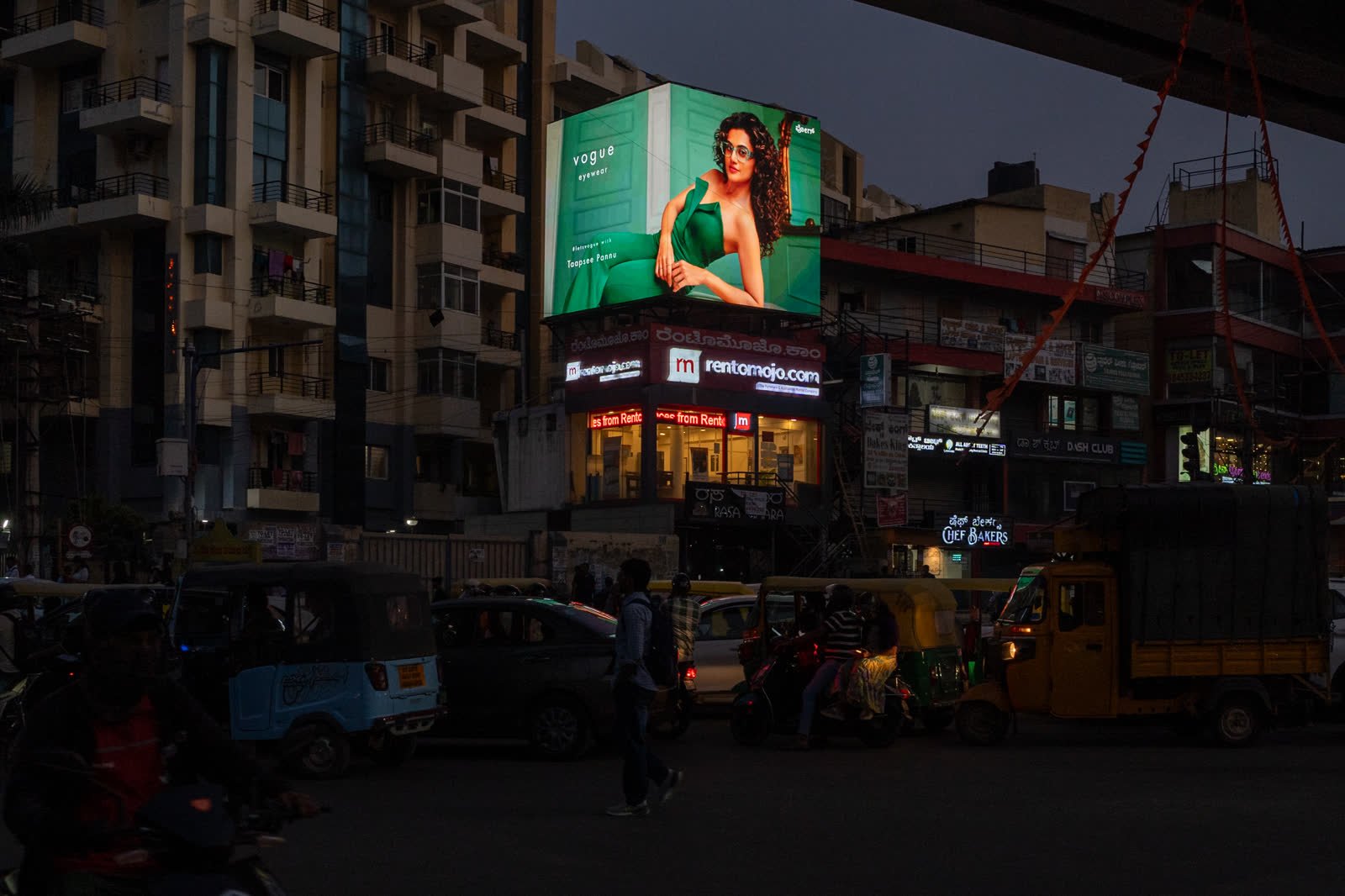
Digital LED Displays
Full-motion creative on the city's landmark facades, sold by the slot.
A digital LED display is a self-illuminated outdoor screen running full-motion or rotating static creative in a timed loop shared between advertisers. It is the one outdoor format that can change message by time of day, run video, and go live within hours rather than weeks, which makes it the natural fit for launches, offers and anything time-bound.
Typical size
LED screens, sized to the structure
Illumination
Self-lit, adjusts to ambient light
Who sees it
Junction traffic, in a rotating slot
Considering digital led displays for a campaign? We will check what is available and send you a quote.
Enquire about Digital LED Displays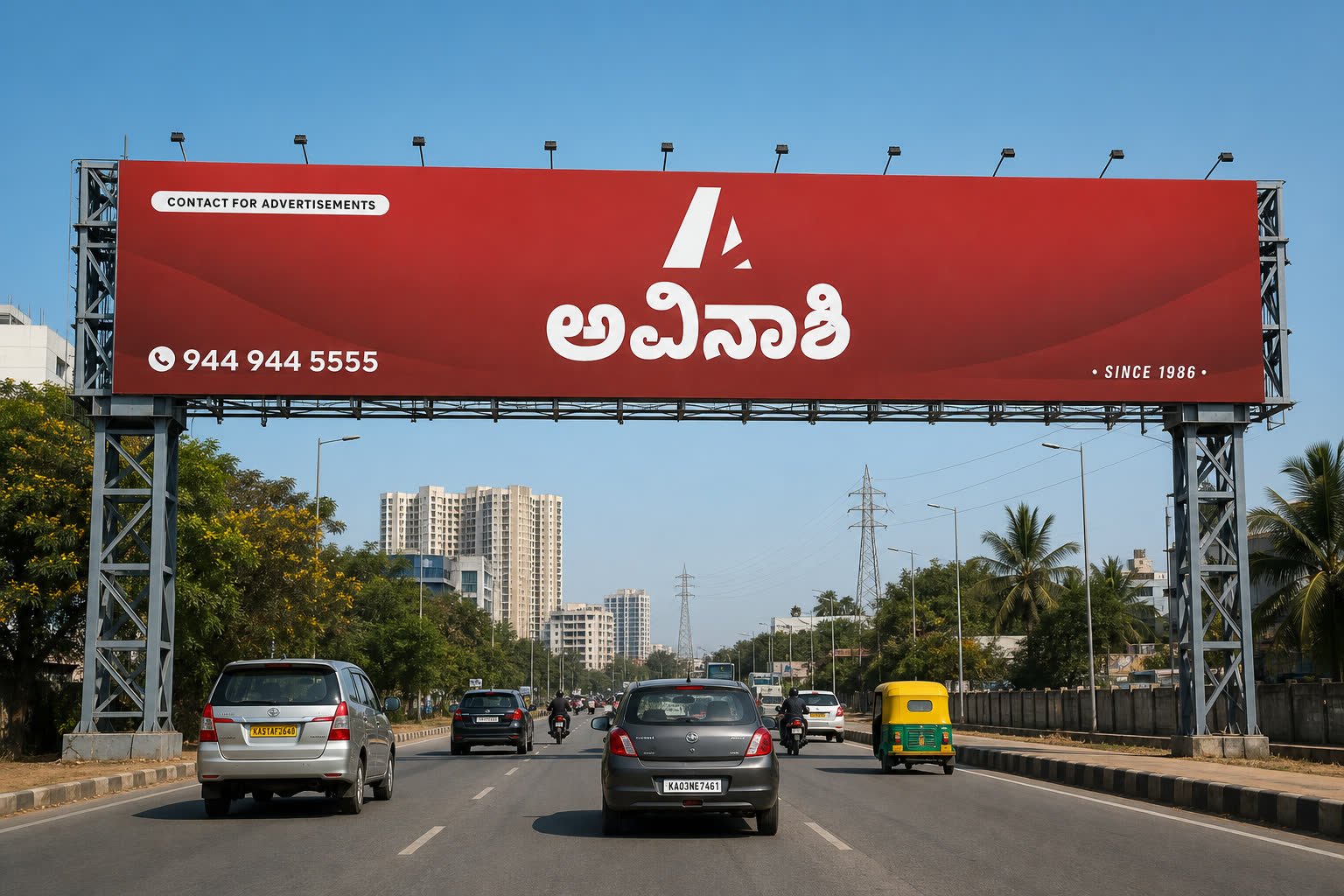
Gantry
The head-on format. Read straight down the lane, not from the side.
A gantry is an advertising structure that spans across the carriageway overhead, so the face sits directly in the driver's line of travel rather than off to one side. It is the only large outdoor format read head-on, which makes it near-impossible to miss and correspondingly demanding on structural engineering and statutory clearance.
Typical size
Wide-aspect, spanning the road
Illumination
Front-lit, backlit on enclosed faces
Who sees it
Drivers head-on, in the line of travel
Considering gantry for a campaign? We will check what is available and send you a quote.
Enquire about Gantry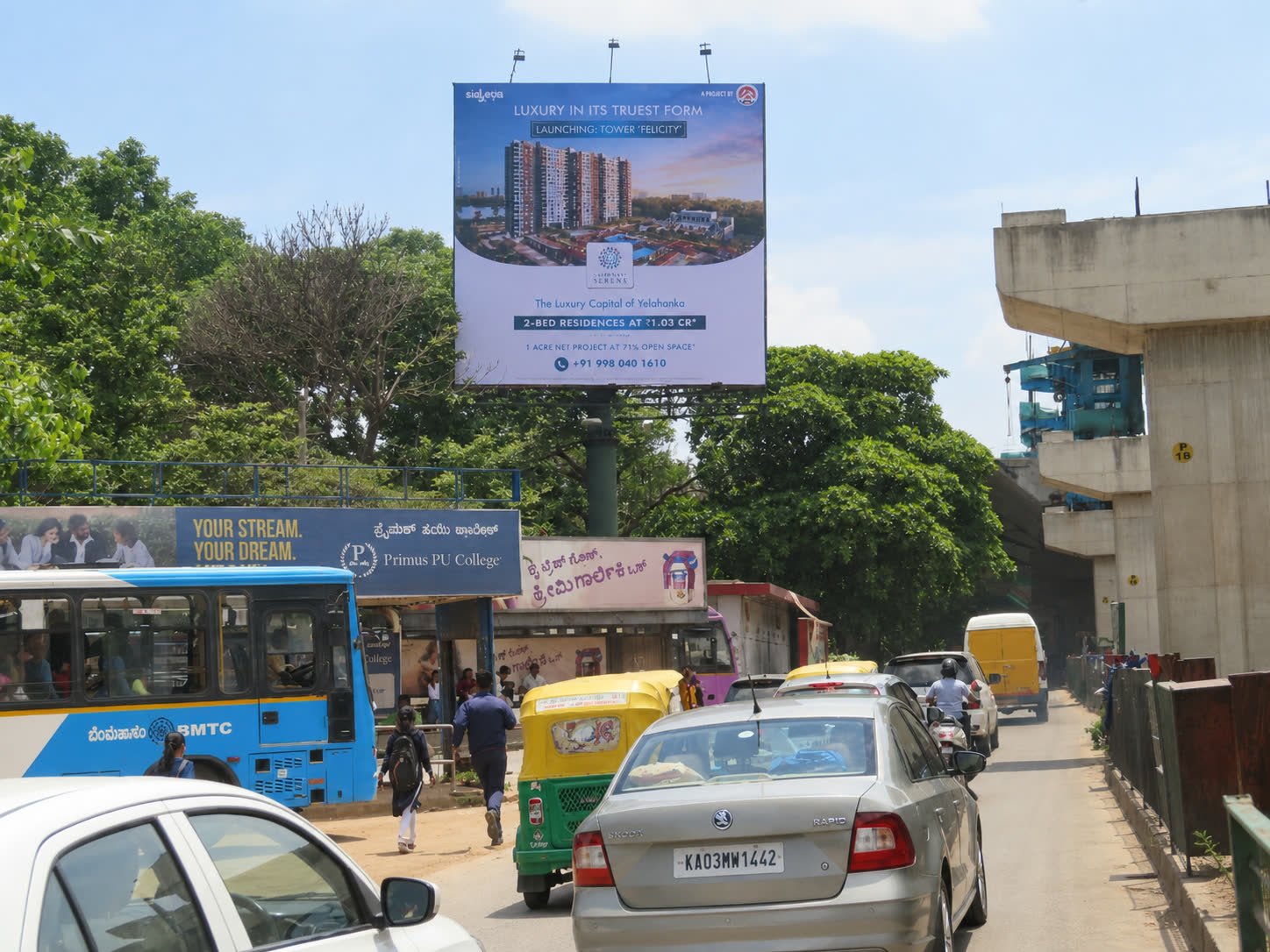
Unipoles
One column, two faces, both directions of travel.
A unipole is a large advertising face carried on a single central steel column, standing clear above surrounding clutter and almost always double-sided so it is read by traffic moving in both directions. It is the format of choice at city gateways and major intersections, where height and a long approach window matter more than sheer face area.
Typical size
40 ft × 20 ft per face, usually double-sided
Illumination
Front-lit after dark
Who sees it
Traffic moving in both directions
Considering unipoles for a campaign? We will check what is available and send you a quote.
Enquire about Unipoles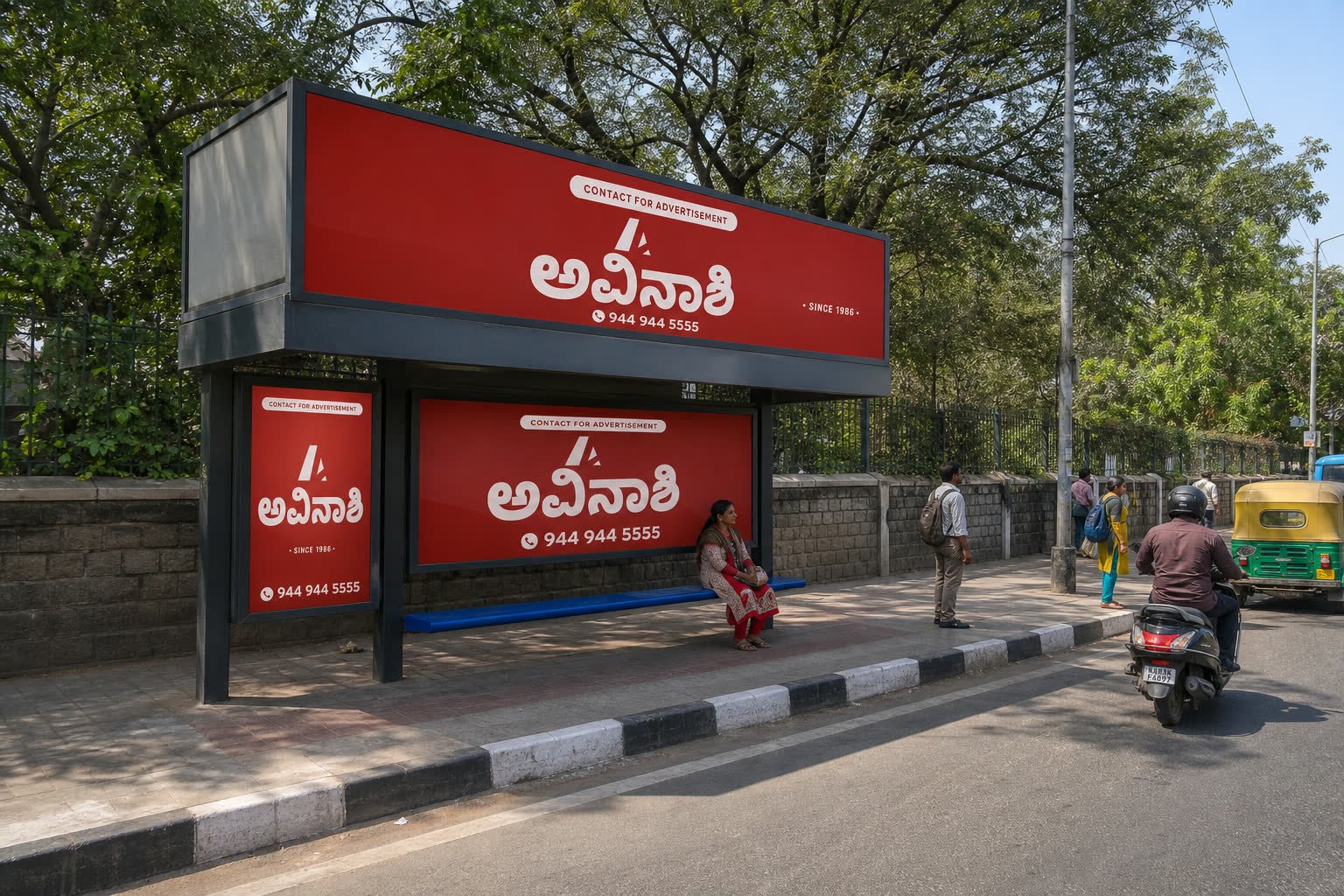
Bus Shelters
The one outdoor format the audience reads standing still.
Bus shelter advertising places backlit panels, typically 6 ft × 4 ft per face, in the structures where commuters wait for a bus. It is the highest-dwell format in outdoor: a waiting commuter gives the panel minutes of unhurried attention at close range, which allows detail that no roadside format can carry.
Typical size
6 ft × 4 ft panels
Illumination
Backlit, switches on at dusk
Who sees it
Waiting commuters, at close range and at rest
Considering bus shelters for a campaign? We will check what is available and send you a quote.
Enquire about Bus Shelters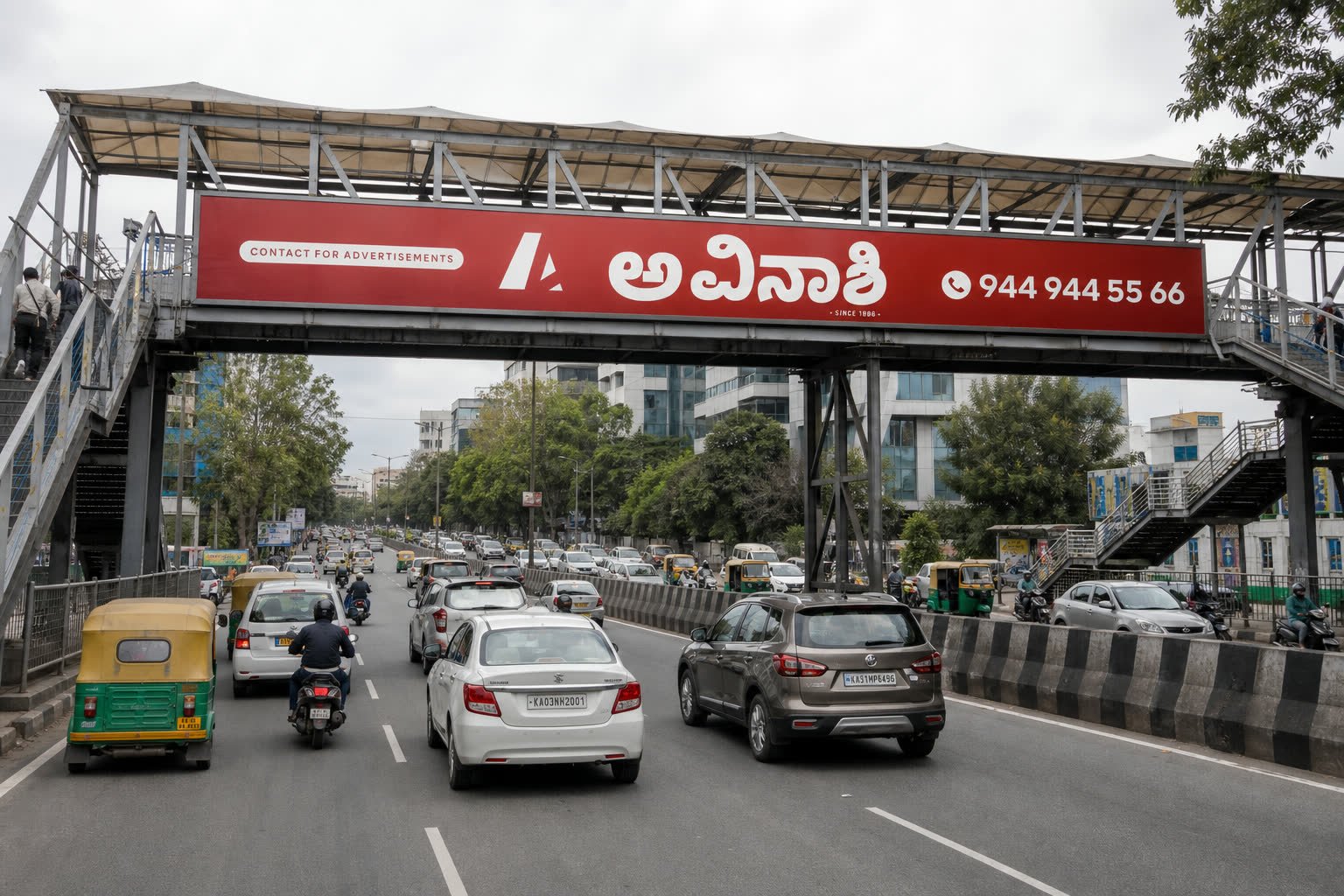
Skywalk / Foot Over Bridge
Two audiences from one structure: drivers below, pedestrians alongside.
Skywalk and foot over bridge advertising uses the pedestrian crossings that span Bengaluru's arterial roads. A single structure carries two distinct opportunities: a broad outward-facing deck panel read head-on by traffic passing underneath, and eye-level faces along the walkway and staircases read at close range by pedestrians crossing.
Typical size
Deck face plus eye-level panels
Illumination
Backlit or front-lit
Who sees it
Drivers below and pedestrians crossing
Considering skywalk / foot over bridge for a campaign? We will check what is available and send you a quote.
Enquire about Skywalk / Foot Over Bridge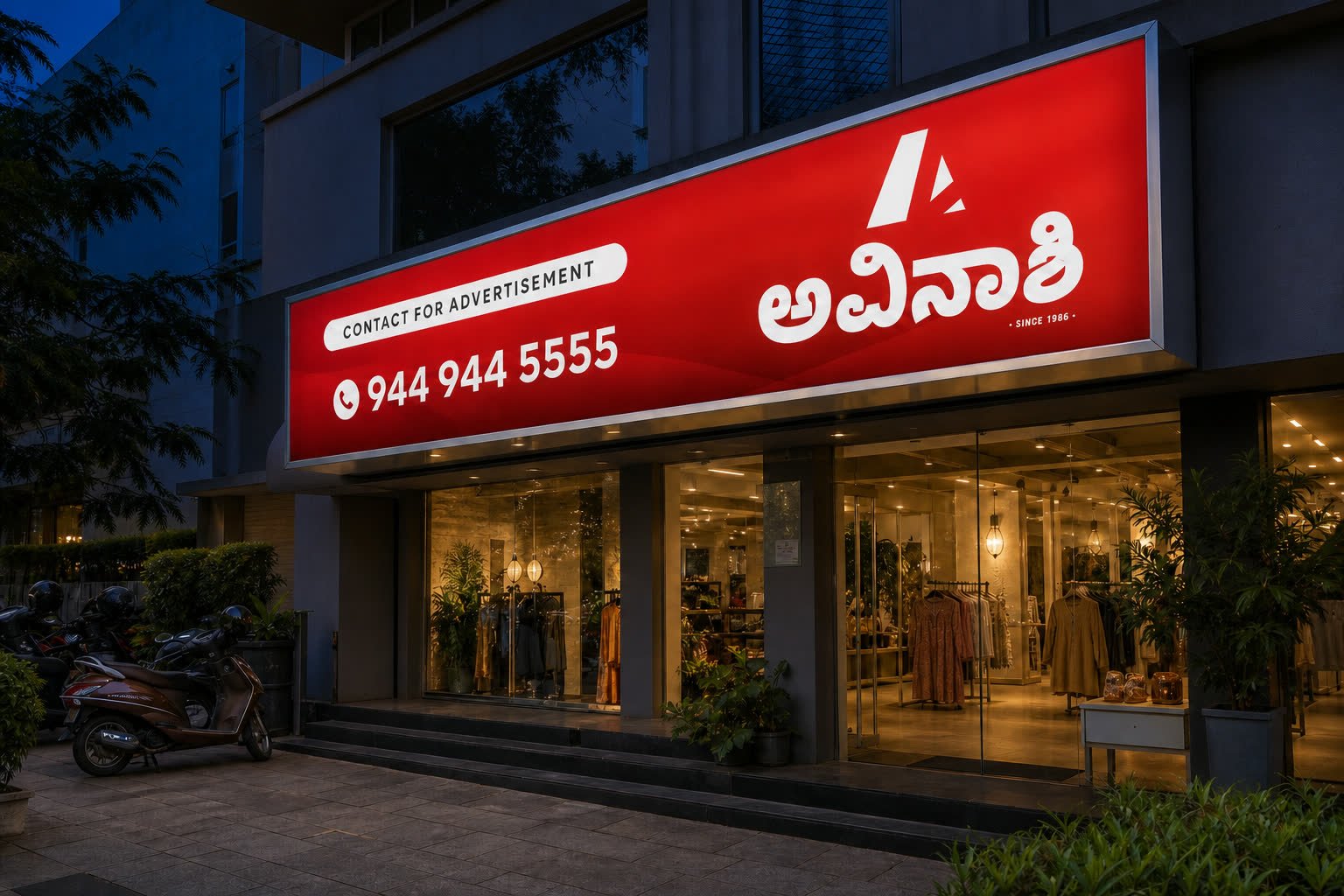
Glow Signs
The sign that finds your shop after dark, fabricated per storefront.
A glow sign board is an illuminated signage unit, typically an acrylic face over an LED-lit aluminium housing, fabricated for a specific storefront. Unlike media formats bought by the month, a glow sign is a manufactured asset that stays with the premises, and the single highest-return signage investment for any retail business that trades after dark.
Typical size
Custom to the storefront
Illumination
Internally lit
Who sees it
Passers-by at your own premises, after dark
Considering glow signs for a campaign? We will check what is available and send you a quote.
Enquire about Glow SignsPrinted or digital?
The distinction people ask about most. Neither is better in general. They suit different kinds of message.
- Share of the face
Printed: The face carries one advertiser for the booking.
Digital: A slot in a loop, shared with other advertisers.
- Creative change
Printed: A new print has to be produced and mounted.
Digital: Changed digitally, with no print or mounting.
- What the creative can do
Printed: One still frame, read at a glance.
Digital: Motion, animation or rotating stills. No audio.
- After dark
Printed: Lit sites stay visible; unlit sites do not.
Digital: Self-lit, so it reads by day and by night.
- Typical use
Printed: A steady presence, with one consistent message.
Digital: Messages that change during the campaign.
Outdoor advertising glossary
The terms that come up in any outdoor advertising conversation. Worth two minutes before your first one.
- OOH (out-of-home)
- Advertising that reaches people outside the home, while they are out in public space: roadside boards, transit, shelters, pedestrian structures and storefront signage.
- DOOH (digital out-of-home)
- The digital part of OOH: LED screens running motion or rotating creative, sold as a timed slot in a shared loop rather than as one exclusive face.
- Face
- One advertising surface. A single structure can carry more than one, and outdoor media is counted per face rather than per structure.
- Front-lit
- Lit from outside by fixtures aimed at the printed surface. The usual arrangement on large roadside formats.
- Backlit
- Lit from behind, through a translucent face, so the artwork itself glows evenly. Used on shelter panels, station media and glow signs.
- Flex
- Weather-grade printed vinyl, the standard material for large printed faces. It is tensioned onto the structure and replaced when the creative changes.
- Dwell time
- How long the audience can hold the advertisement in view. Minutes at a shelter, seconds on a fast road. It is what decides how much the creative can say.
- Approach
- The distance over which a driver can see a face before passing it. A long, clear approach is worth more than raw size.
- Catchment
- The area a campaign needs to reach, usually a radius around a store, project or branch rather than a whole city.
- Loop and slot
- On a digital screen, the loop is the full rotation of all advertisers' creative and the slot is your place in it, replayed continuously.
- Changeover
- Replacing the creative during a campaign.
- Illumination
- Whether a face is lit, and how. It determines whether the advertisement is working during the hours after sunset.
Outdoor advertising: frequently asked questions
What are the main types of outdoor advertising in Bengaluru?
Eight formats cover most outdoor advertising in the city: hoardings, transit media on metro and bus, digital LED displays, overhead gantries, unipoles, bus shelter panels, skywalk and foot-over-bridge media, and glow sign boards. They differ mainly in who sees them and for how long.
What is the difference between a hoarding and a billboard?
None, in practice. Hoarding is the common term in India for what is called a billboard elsewhere: a large printed roadside advertising face on its own structure.
What is the difference between OOH and DOOH?
OOH is out-of-home advertising in general. DOOH is the digital part of it: LED screens carrying motion or rotating creative. On a printed face the advertisement stands alone for the booking; on a digital screen it appears as a timed slot in a loop shared with other advertisers.
What is the difference between a hoarding, a unipole and a gantry?
They differ in how they are mounted and therefore how they are seen. A hoarding is a face on a ground- or terrace-based frame, read from an angle. A unipole rises on a single central column and usually carries two faces addressing both directions of travel. A gantry spans over the road, so it is read head-on in the driver's line of travel.
Which outdoor format has the highest recall?
Large roadside formats such as hoardings and unipoles generally deliver the strongest recall, because the same people pass them repeatedly on routine journeys. Recall in outdoor advertising comes from repetition over time rather than from a single viewing.
Should I choose printed or digital?
Printed formats suit a single consistent message held over a period. Digital suits campaigns whose creative needs motion, or needs to change during the run, since the artwork is updated without producing and mounting a new print. Many campaigns use both.
Which formats work for a detailed message?
Formats the audience reads at rest and at close range, such as bus shelter panels and pedestrian-level panels, can carry more text, an offer or a QR code. Formats passed at speed need very few words and one clear brand cue.
Do outdoor advertisements need permission in Bengaluru?
Yes. Outdoor advertising in Bengaluru falls under the Karnataka Open Places (Prevention of Disfigurement) Act, 1981, together with the advertisement bye-laws of the relevant civic body, and requirements vary by format and by location. The rules have changed several times, so permissibility is established for each specific site at the time it is booked.
How much does outdoor advertising cost in Bengaluru?
There is no single citywide rate, and any figure quoted for a whole format is guesswork. Cost depends on the individual location, the duration, whether the face is illuminated, and how many faces a campaign takes. We quote against a specific brief, so get in touch and we will send you one.
How far in advance should outdoor advertising be booked?
As early as the campaign window is known, particularly around festival periods and major launch seasons, when demand across the city rises at once and well-placed sites are committed ahead of time.
How long does an outdoor campaign usually run?
Printed formats are commonly booked by the month, the quarter or the year. Digital screens can accommodate shorter flights because there is no print to produce. Glow signs are different in kind: a sign is manufactured for the premises and stays with the business.
What artwork is needed for an outdoor advertisement?
Artwork is prepared to the exact dimensions of the face being used, and we supply those once a format and site are confirmed. The rule that matters most is legibility at a distance, which is a stricter test than legibility on a screen.
Not sure which format you need?
Most campaigns end up using more than one. Tell us who you are trying to reach and when, and we will recommend the formats that fit and send you a proposal.
- Call
- +91 94494 45577
- Operating since
- 1986, across Bengaluru and Karnataka